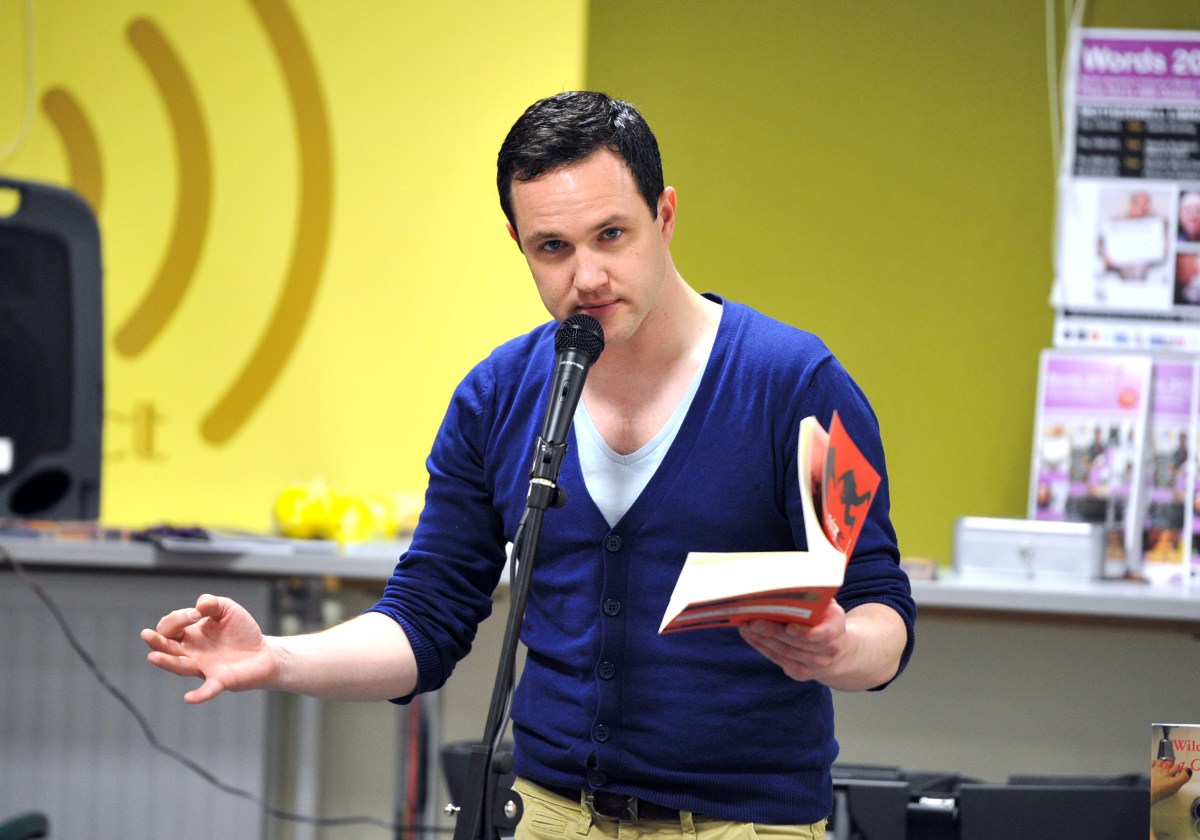
Plays : Times When I Bite (One Man Show)
Author & Performer - Video Excerpt
Feature from The Times Online (and below)
Return to Page
Times When I Bite, Alan Bissett - Drawing on his female intuition
The novelist is about to take to the stage in the guise of ‘Falkirk’s hardest woman’, but says it’s anything but a drag...
The physical condition of authors is not something we tend to consider much, which is as it should be, given they’re a species who live in darkened rooms eating HobNobs and their own fingernails. The close-up view of most writers is something over which we’re best drawing a veil — and perhaps a tarpaulin.
Which is why a lunchtime with Alan Bissett is rather out of the run of things. The 34-year-old novelist and playwright ponders today’s menu, and opts to forgo its bulkier options for several splots of vegetarian haggis and turnip. Such are the necessary disciplines when you’re due not only to appear on the public stage, but to do so as a member of the opposite sex: “She’s wiry, this woman,” Bissett says “There’s no flab on her.” Perhaps we will learn to call this approach — which he uses in his play Times When I Bite — Atkins drama. Certainly it isn’t one we can easily picture, say, blokey old James Kelman taking.
Bissett belongs to a different, younger generation of Scottish writers, one whose meditations upon gender, class and identity are shot through with the vivid trivia of pop culture and a stylistic playfulness.
Informally dubbed the “Glasgow G7”, it’s a cabal that includes Louise Welsh, the author of The Cutting Room, her other half Zoë Strachan, Rodge Glass, the biographer of Alasdair Gray, and the novelist Nick Brooks. Altogether, it’s a fresher-faced, though equally incestuous, update of the writers’ cliques established in the Glasgow of the 1970s, formed not in the howffs of yore but around the MLitt course in creative writing at Glasgow University.
They’re a gathering as acquainted with the Scottish urban gothic as any of their predecessors — much of Bissett’s writing is set on the fierce Hallglen scheme in Falkirk, where he grew up — but they’re determined to fuse that with the sexier, sleeker tropes of postmodernism, erotica, quasi-autobiography and television drama.
Bissett’s forthcoming novel, Death of a Ladies’ Man, meanwhile, borrows its title from a Leonard Cohen album. It follows two others, Boyracers, a coming-of-age road tale, and The Incredible Adam Spark, concerning a fast-food worker with learning difficulties: “Two autism novels came out around the same time, mine and The Curious Incident of the Dog in the NightTime,” he says. “I’m sure you can guess which one sold . . .”
For the G7 group, the job doesn’t stop at the typewriter. A number of them were involved in the Ballads of the Book project, in which such old reliables as Gray and Edwin Morgan were set to modern Scottish rock music. His next theatrical work The Ching Room, meanwhile, is set within the Beckettian confines of a nightclub toilet cubicle, as a coke dealer and his customer share their loathing of women. Again, not really Alexander McCall Smith territory.
“I was listening to a collection of 1980s hits as I was washing the dishes the other day,” Bissett says, “and that Adam Ant song Prince Charming came on. It had a line that seemed very relevant to playing a woman, the line being that ridicule is nothing to be scared of.
“Acting as a woman, I admit, is not the most obvious career step for a Scottish novelist,” he adds. “There’s no templates or precedents, except for real women such as Janice Galloway or Liz Lochhead. You assume you’re opening yourself up to charges that you don’t take the craft seriously. The condition of being a male Scottish novelist, I think, is the condition of wrestling with Kelman. In his way, though, Kelman made a virtue of deviating from the set text, and that’s what I’m doing in my way.”
The “one-woman show” was written as a reaction to the four years of confinement undertaken to complete Death of a Ladies’ Man, as Bissett strove to depart from the demotic and colloquial rites of passage found in his first two novels. A kind of cabin fever descended, he says, and the idea of writing quickly for immediate response assumed a compelling sway. A similar impulse has seen him take to reading his work as support act for bands such as the Vaselines and Zoey Van Goey.
The leading principal of Bissett’s life, though, lies in reconciling where he came from with where he’s landed. He seems somewhat self-conscious that his raw material, the adolescent deprivations of the west central sink scheme, is in such marked contrast to his subsequent life — he took a first in English from Stirling University and became a full-time author after seven years teaching creative writing at Leeds and Glasgow.
He enjoyed a strange kind of privilege when still living in Falkirk, insulated from bullying because his family were the scarier than the bullies: “Even now I can’t bear starting sentences with the phrase ‘During my working-class background . . .’ because I make yourself sound like something from The Road to Wigan Pier. But my family were huge, vast and . . . hard. I was a geek but I was protected. My cousins dealt with any trouble that came my way.
“And I can’t prettify my background. There was a lot of casual racism and there was casual violence. The only thing in Hallglen that wasn’t casual was the drinking culture. I can’t spare their blushes, but there was a truth and dignity in their everyday lives. No matter what I say about Hallglen, no matter how I write about it, I’m always going to sound like a member of the condescending middle-classes.”
For its part, Times When I Bite has Bissett embody “Falkirk’s hardest woman”, Moira Bell, as she explains the finer points of the etiquette that govern life in Scotland’s less salubrious corners; the emotional terrain of women on the verge of nervous breakdowns, bedevilled by male fecklessness and the cunning of female peers. “The voice comes from the women in my family, my three aunties and my sister, who are great storytellers and hard as f***,” he says. “If they were to go on stage and talk about their lives in their own voices, it would be acclaimed as a virtuoso performance.
“In the theatre of their living room, you should hear these women talk, they’re like a hydra, this multi-headed beast that finishes its own sentences. So why wouldn’t I use that background and let these women speak through me, as utterly pretentious as I know that sounds.”
His performance as a woman, however, is not a drag act, Bissett hastens to make clear. The femininity of the portrayal lies in the way he has written the character, he says, in her speech rhythms and posture: “It’s not camp, Moira is too violent to be camp.”
Bissett has performed the piece several times at literary events and authors’ nights and, to his surprise, the trickiest reactions have come from women. Partly there’s a class angle involved, he says, as audiences query his right, as a member of the academic bourgeoise, to masquerade as a single mother with a cleaning job in Falkirk.
They imply, he says, that he is perpetrating an act of gender colonisation: “I could see them trying to work out if my playing a woman was offensive or not,” he recalls. “So for no other reason than to investigate why a woman might think that, I thought, ‘Sod it, I’m going to make this statement’. If it provokes condemnation, fine, as a subject that shouldn’t be ignored.”
Few, he goes on, query the right of authors to write characters of the other gender: “The creative act is one of empathy, whether intellectually, emotionally or, in my case, physically. Times When I Bite is an object lesson in empathy, I hope. After writing a novel about being a man for four years, I wanted to get the hell out of men. I wanted to not only write a female part but be a female part.
“I’m not able to say, ‘Well, now I know what it’s like to be a woman’ — that’s clearly untrue and patronising — but I’ve learnt a lot of men would do better if they tried to think like women.”
Times When I Bite is at the Mitchell Library, Glasgow, as part of the Aye Write! festival, Friday 13 March and then at the Traverse in Edinburgh.
Return to Page |